
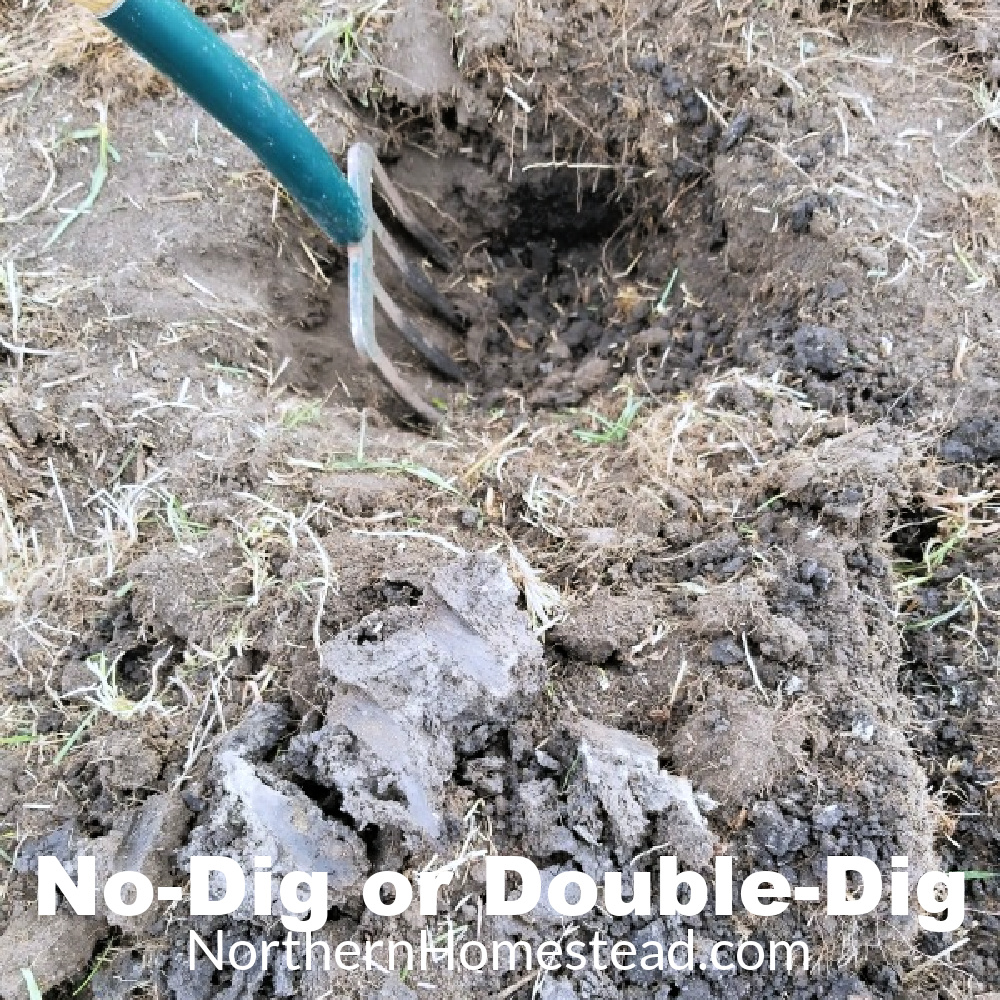
No-dig or double-dig the garden soil is a question that, like most garden questions, can not be answered with YES or NO – it always depends. If you follow us, you know we are big advocates of the no-dig method, and we mostly refer to it as no-till. Overall, it is better for the soil life, and if in doubt about what to do, go for no-dig. However, there is a time when digging can be good, and not just simple digging, but double-digging.
Let’s start at the very beginning and cover the subject from a simple gardener’s perspective, not from a scientific one. After all, we are gardeners, and we write for gardeners.
Understanding soil layers
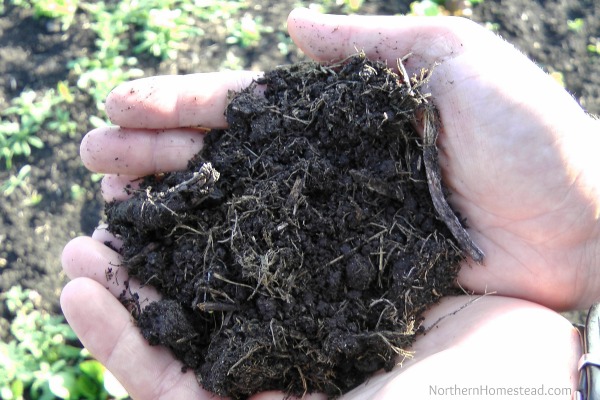
Soil, as we know it in our garden, consists of topsoil and subsoil (undersoil). The topsoil, often simply referred to as garden soil, is what we, as gardeners, are normally concerned with. The topsoil is the soil we grow plants in.
The term ‘build good soil’ refers to the topsoil. We want to build up a good amount of soil on top of the subsoil.
The subsoil, or undersoil, lies below the topsoil. It often has a higher clay content, is harder, is often lighter in color, and is generally unsuitable for plant growth. However, it is still important. The subsoil is where deep-rooted plants find their support, and it is also the place where excess minerals go.
Why no-dig the garden soil
Now, just by reading about these two very different soil layers, it seems logical that mixing them would not be a good idea. And you are precisely right.
If, for example, you have 3 inches of topsoil and work with a 6-inch-deep tiller, you will get 6 inches of topsoil and subsoil mix. At the time of tilling, you might not notice what just happened because the soil will look lighter, and since the tiller pulverized everything, it will be loose and nice.
Note that some tillers go as deep as 10 inches. If you use one of those, be especially careful.
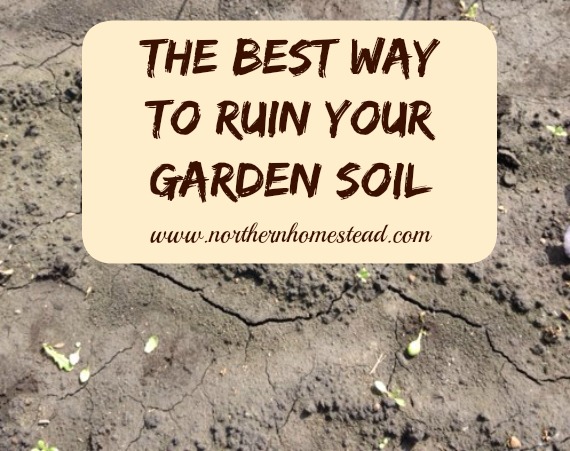
A few weeks into the growing season, that freshly tilled loose soil turns into hard rock, and you wonder what happened to the soil. You might also argue that your grandpa always tilled and his garden was beautiful. It is very possible that grandpa hadat least 10 inches of topsoil, so tilling did not do as much damage to his garden as it does to yours. Of course, these are all just examples to illustrate how there is no “one-size-fits-all” approach to gardening.
We want at least 6 inches of good topsoil in the garden to grow healthy plants. If your garden has struggled to grow, it might be that instead of building up good topsoil, you have been mixing topsoil with subsoil, resulting in poor-quality mixed soil.
For existing gardens, we recommend stopping tilling and building up the soil by adding compost on top. You can read more about it in Till or Not to Till the Garden.
If you absolutely want to continue tilling, work in a good amount of compost every time. Over time (read years), you will improve that tilled top layer of soil.
Starting a new garden plot
If you are starting a new garden bed, it would be advisable to assess the quality of the topsoil and subsoil. Simply dig a vertical hole to expose the layers. Once digging becomes harder, you have usually reached the subsoil.
In a new subdivision, you are very likely to have almost no topsoil. It is common practice, at least in our region, to start a new subdivision by scraping off the topsoil with heavy machinery. If you do not find a subsoil layer and the soil is hard to dig, it is fair to assume there is no topsoil worth talking about. All you can do here is loosen up the subsoil with a fork, do not turn, and cover it with one of the no-till options.
When converting a field into a garden, keep in mind when and how the topsoil has been worked/cultivated. You might find the same situation as in the tilled garden, with shallow topsoil that mixes with subsoil.
Again, the best way to deal with it is to cover the soil with organic matter to build up that desired topsoil.
When and how to double-dig the garden soil
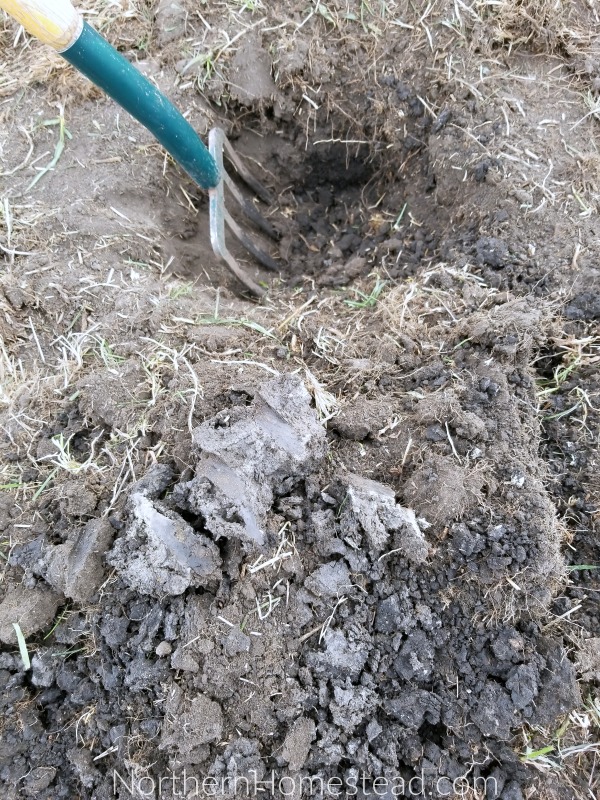
By double-digging, we separate the topsoil from the subsoil and loosen them both.
We already covered that mixing the topsoil with the subsoil is not a great idea. But in a situation when there is very shallow topsoil, let’s stick to our example of 3 inches, taking that off, and loosening the subsoil might be a great idea.
Another situation where you would want to double dig is when the subsoil is very hard. It might consist mainly of clay. A subsoil like that will act as a pond liner under the garden soil. If a garden constantly floods during a rain event and does not drain well, you might have too much clay under your topsoil. Loosening it up by adding organic matter will make a huge difference.
Once the subsoil has been loosened up and readied, the topsoil can be put back in place, preferably followed by 3 more inches of good organic mulch.
Here is a video that might be helpful to see how to double dig.
Alternatives to double-digging
Since double digging is a lot of work, there must be an alternative, and there is.
A garden that has poor soil, not enough topsoil, and/or compact subsoil will make itself known by growing deep-rooted weeds like dandelions, bitter dock, and goldenrod. Those weeds are there for a reason; they are on a mission to loosen up the soil. Getting them out of compacted soil is almost impossible. Nature is holding on to them for life.
If you cannot double-dig to improve the situation, use those weeds to help. Let the weed grow so the roots can go deep, then use a sharp knife or garden shears to cut the plant at ground level. If the plant cannot photosynthesize, the root will die. Aggressive weeds might need more than one cutting, but it still works.
We would also recommend planting some more deep-rooted plants for the same purpose. Forage Radish is a great plant for loosening your soil. Again, do not harvest the root; let the roots go deep and die there. The roots will decompose, leaving open channels for water and earthworms to come in.
Double digging takes care of the problem much faster, but nature has a way to deal with it, too.
Using a Broadfork
Last, not least, let’s talk about using a broad fork. A simple garden fork can be used, too, and in our urban garden, that is all we use. But for a bigger garden, a broad fork is a great tool.
Contrary to tilling or digging, a fork only loosens the soil and does not disturb the layers. Simply drive it into the ground, wiggle a bit to loosen the soil, and pull it out. Do not turn the soil. Repeat every few inches. That practice will not improve the subsoil if it has too much clay, but it will at least loosen the soil to the depth of the fork.
Using the fork in combination with deep-rooted plants will improve the soil over time. Each year, add a layer of mulch on top to build the topsoil.
Hope this helps you understand dig, no-dig, and double-dig better. If you have experience with double dig, please share in the comments below.
We invite you to subscribe to Northern Homestead and follow us on Instagram, Facebook, or Pinterest for the latest updates.
More posts you might enjoy
NEWSLETTER SIGNUP

Thank you Anna for making this clear. I think I finally understand what is so special about topsoil. I guess mixing in the subsoil takes away the good character of the topsoil and makes it too heavy for plant roots. I thought I was helping my forest topsoil (which did not hold water) by mixing in the clay subsoil with the 8 in tiller since clay holds water better. Well, I guess not. I am n0w just using compost and manure to mix into the topsoil to enrich it and hope it will not dry out so quickly.
Using compost in topsoil is always the better option.
I’ve read one article after another about how to double dig and it seems that everyone has a different definition. At first I thought I had a consensus – dig a trench 12″ deep, move over, dig another one and toss the dirt into the first trench, and so on. Simple enough. Now I’m reading that the soil has to be loosened with a fork to twice that depth and compost added before filling a trench with dirt. What if my clay soil can only be loosened with a matlock? And now apparently I have to be careful not to mix my topsoil (if I even have any) with the subsoil. My plot is essentially composed of backfill on top of of hard-packed slate, on which we do have some grass and weeds growing but no topsoil to speak of, or so it appears. Now that I’ve already dug my first trench (but not yet loosened the stuff at the bottom) could I please have a consistent explanation for how to proceed?
As you have already noticed in your plot, there are so many types of soil, subsoil, no soil, etc. So one-size-fits-all is literally not possible. As I understand what you are doing with your trench is simply moving soil from one spot to another. That’s not double, but single dig. Not sure why you would want to do that. The idea with a double dig is to loosen the lower layer. In your case, it seems that you do not have good topsoil at all. So your problem is not so much a compacted subsoil, but a compacted soil altogether.
To give a suggestion from just what I read here is difficult, so take it with a grain of salt. Loosen up your soil with whatever you can. The way you started would work, but I would not recommend double dig for now. After that add a thick layer (3 inches at least) of good compost or a mix of good topsoil and compost. Plant in that. Build up that topsoil each year and you will have a great garden.
Hello!
We live in Western WA (in a wooded area in Puget Sound) and are in the process of converting a compacted gravel parking area back into a usable yard with hugelkultur berms and native plants. The gravel was layered over a good foot (give or take) of shale rock that was used to level the ground many years ago before we arrived. Then heave equipment just sat there for a long time. So, it was pretty much like dead dirt with weeds in it.
In the Fall of 2021, we did the following:
– Pulled out all the gravel with an excavator (not an ideal tool for the earth but necessary)
– Loosened up with soil with that excavator while pulling out all the gravel
– Applied about 3+/- inches of topsoil
– Planted a cover crop (rye and fava beans). We let the rye go to seed.
It is now Spring 2023. Some rye is growing and there are more seeds waiting to germinate this Spring. Should we throw down some more cover crop seeds and keep it from going to seed this time around? Or should we till, which everyone tells us to do? If we do, we’ll just wind up mixing in the lousy soil with the good soil on the top and that doesn’t make good sense to me. I’m thinking we should rely on the cover crops and shrubs/trees we plant to help improve the health of the soil over time.
Any input is welcome.
Thank you!
Kristen
First, thank you for sharing. We love real-life examples. As you already know tilling would mix your new topsoil with whatever soil was there before. Depending on what kind of soil it was, it would be desirable or not. Also, depending if you want to start growing something else there this year or not, you could do nothing, just not let the rye go to seeds again, or you can move the rye really short as soon as it has all germinated. The rye will die off and you can plant. This is a method we do not use, but here is a link to read more: no-till-garden-in-spring
Great explanation! I have grass in clay soil, and want to make it landscaping with shrubs and flowers. Should I kill the grass then remove it with a sod cutter? Or just kill it, cover with cardboard and mulch before double digging holes for shrubs? Thank you for all the great info!
We have had good results for a perennial yard with covering the grass with cardboard and adding a thick layer (about 3 inches) of wood chips.