
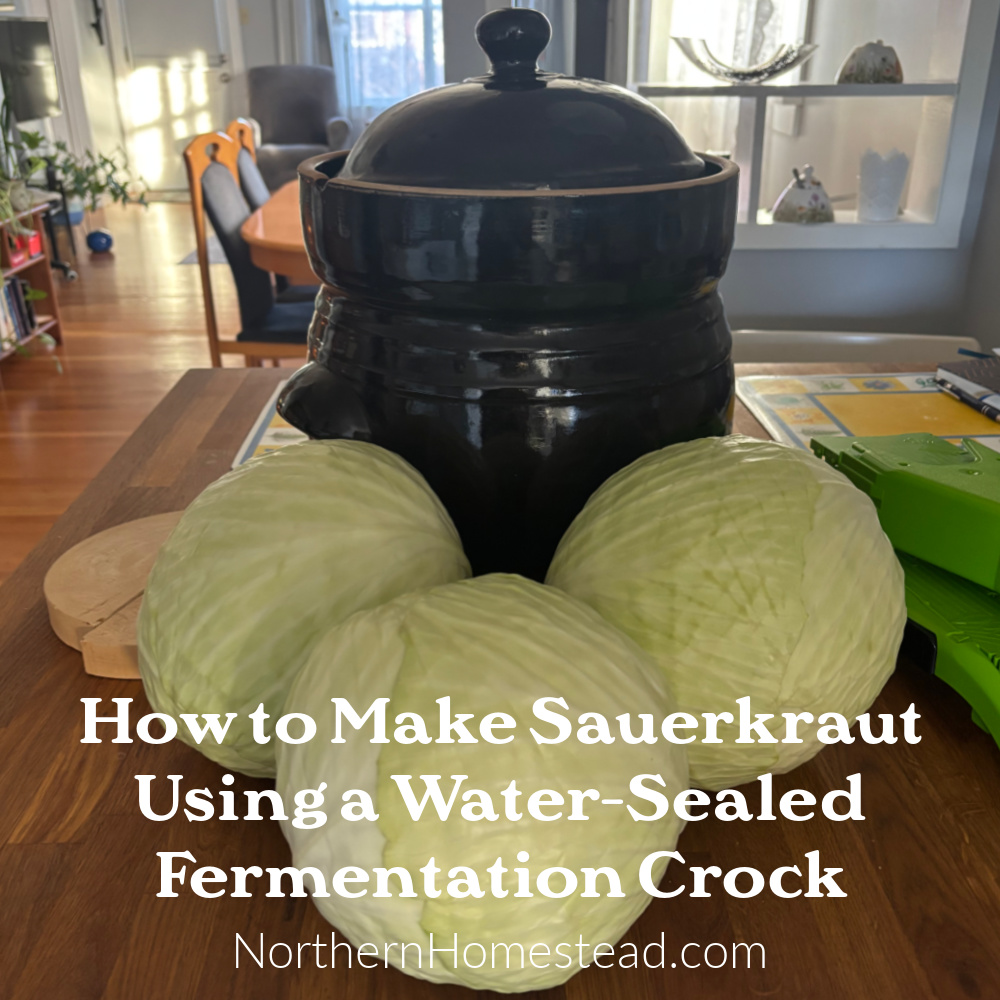
Sauerkraut is a staple in our household. Since we began using a water-sealed fermentation crock, both the quality and quantity of our sauerkraut have significantly improved. Especially during the winter months, this delicious and nutritious food adds crunch, beneficial bacteria, and flavor to nearly every meal. If you’re not a fan of winter lettuce, consider making sauerkraut instead. In this blog article, we share step-by-step instructions for making sauerkraut in a water-sealed fermentation crock.
We have been making smaller batches of sauerkraut the simple way for many years. If you just want to try making sauerkraut, we would suggest you head over and read that blog article. In this article, we focus specifically on the water-sealed fermentation crock and larger batches of sauerkraut. If either of these interests you, keep reading.
What do you need to make a bigger batch of sauerkraut in a crock?
Helpful tools:
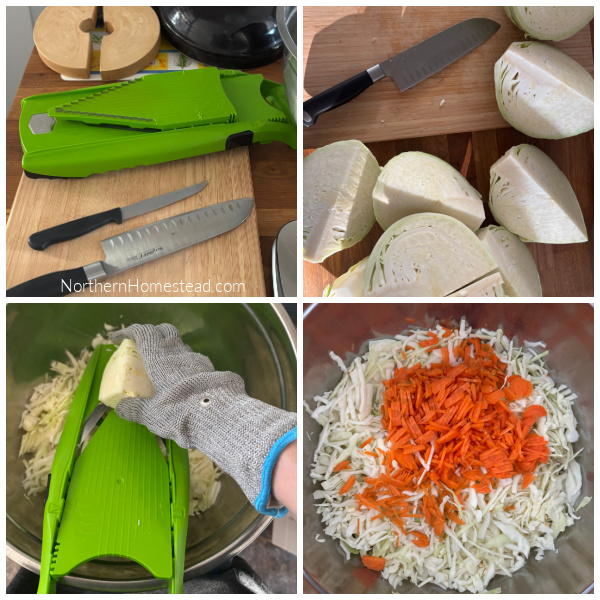
These are the tools that are helpful when making a bigger batch of sauerkraut. There are Amazon affiliate links, from which we receive a small commission.
A water-sealed fermentation crock. We share more about the crock in this blog article.
Weighing stones, they often come with the crock; if you do not have them, you will need them to weigh the saurkraut down.
A Kitchen scale, to know how much salt you need. We recommend using a scale, which is much easier than guessing.
A good kitchen knife or knives, whatever you are comfortable using.
A bigger-sized cutting board.
A cabbage shredder, there are many options. We use the Boerner Mandolin. It’s a high-quality product that has many uses, not just for cabbage.
Protective gloves are a must when using a mandolin slicer.
A container for mixing sauerkraut, such as a bowl or a bucket.
A sauerkraut pounder is a helpful tool.
A baking sheet, to place the crock pot on to catch any overflow.
Cabbage and Co:
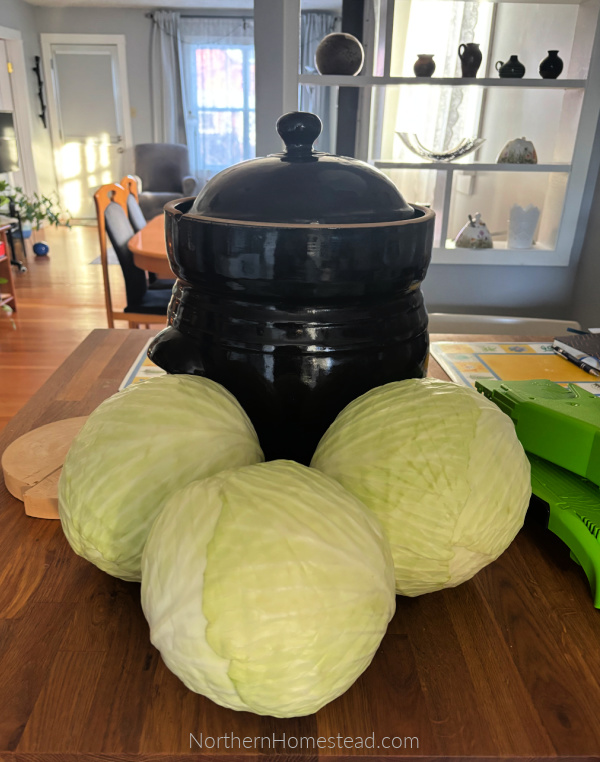
For making sauerkraut, you need cabbage and salt; that’s it. Those two ingredients will make a naked sauerkraut.
2.20 pounds (1 kg) of cabbage
1 tablespoon (20 grams) of non-iodized salt yields a 2% salt-to-cabbage weight ratio.
However, we prefer less-salty 1.6% sauerkraut and enjoy adding other vegetables to enhance the flavour. That’s where a kitchen scale and your imagination come in.
Salt for sauerkraut
Let’ls talk salt first. It is important to use a non-iodine salt. Other than that, it can be any salt you like. We usually use coarse pickling salt. As the name already says, it’s great for pickling. If you like more expensive pink salts, go for it.
The amount of salt depends on the amount of vegetables and on your preferred saltiness. For fermentation to work, it is generally considered to be 1.5% to 2% of the cabbage’s (and other vegetables’ if used) total weight. Salt is the most important ingredient that turns vegetables into a fermented product. You need enough salt to make it safe. If you don’t mind it being very salty, you might be able to get away without a scale and calculation. However, sauerkraut tastes better when it is not too salty. Adding more than 2% will slow down the fermentation. That being said, some prefer a 2.25% sauerkraut. Find what works for you.
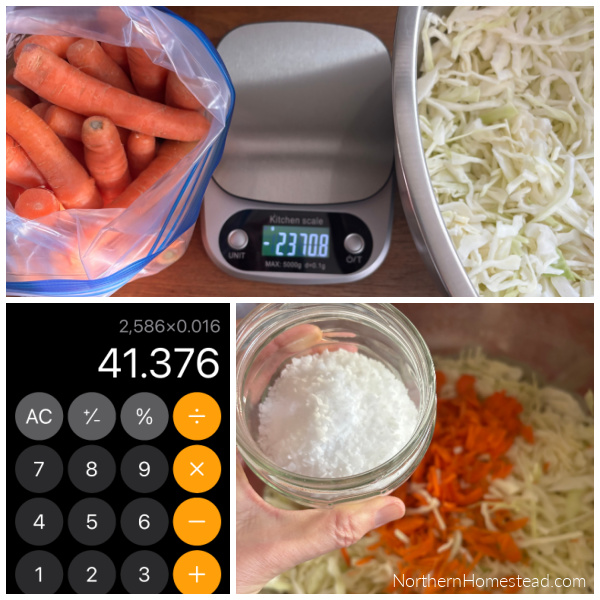
The easiest way to calculate how much salt to add is to shred or chop the vegetables, then weigh them. Make sure to subtract the container. Now do some simple math, for example (See picture above) 2,586 grams of cabbage and carrots times 0.016 (the percentage of salt we wanted) equals 41.3 grams of salt. For beginners, we would recommend using more salt, since there is a lower risk of something going wrong. If you’re going for a 2% salt, use o.o20 in your calculation.
Cabbage and other vegetables
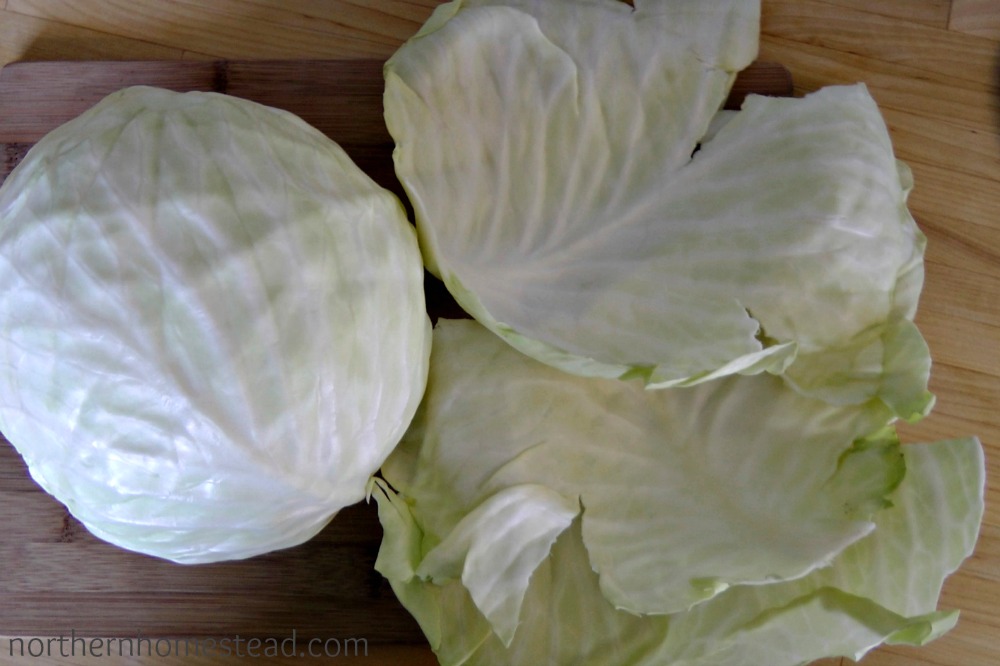
As we said before, cabbage is all you need to make sauerkraut. When growing or shopping for cabbage, look for sauerkraut varieties. These are denser heads, with thin leaves. When shopping in store I often lift the heads and take the heaviest. They make great sauerkraut. The juicier summer cabbage is better suited for stewed cabbage.
How much cabbage do you need to fill a crock? As a rule of thumb, the amount of cabbage can be measured in kg, the same as the crock’s size in liters. Or pounds to pounds for our American friends. For example, a 10-liter crock can hold 10 kg of cabbage (including other veggies if used). You do not have to fill the crock to the top; in fact, it is easier to start with less. 8 kg (Approximately 16 pounds) is a great amount for a 10-liter (Approximately 20-pound) crock.
Besides white cabbage, you can also use red cabbage, or mix the two for more color. You can add carrots, apples, beats etc to your liking. Our favorites are carrots; adding 10% of carrots to the total weight of cabbage results in a flavourful sauerkraut.
Spices
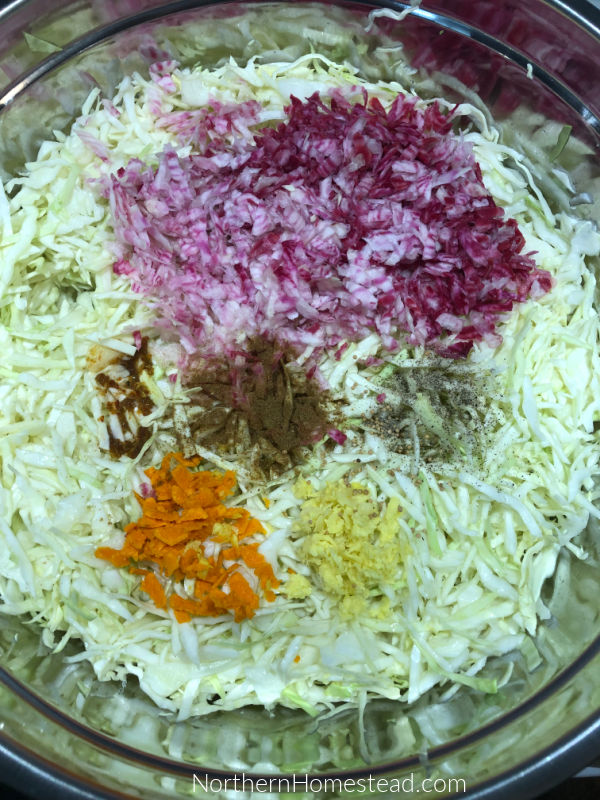
To the base recipe of cabbage and salt, you can add ginger, turmeric, garlic, onions, and any spices you love. If you are adding a lot of spices, see the picture above, make sure to weigh them before calculating and adding salt. Salt is still the most important ingredient for the fermentation to work.
Preparing the produce for fermentation
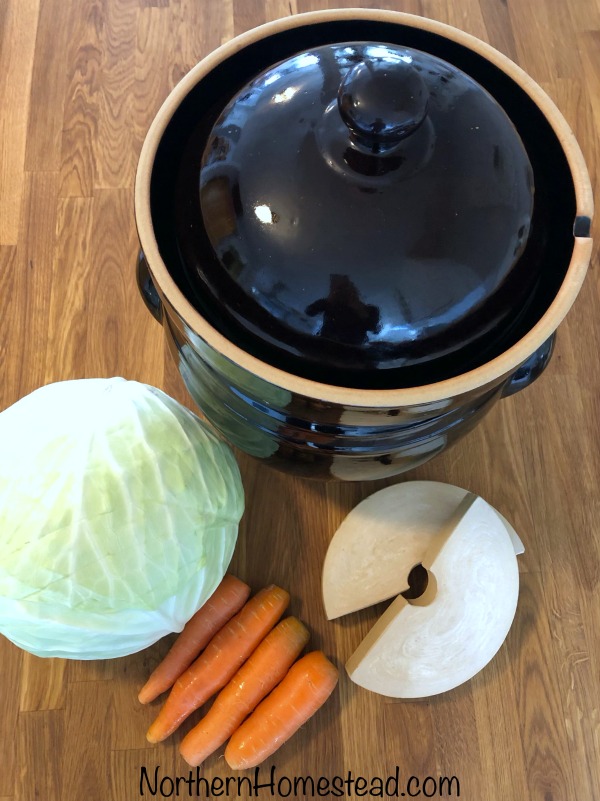
Remove the outer leaves from the cabbage so it is nice and clean. Then take three to six more leaves off to cover the sauerkraut for the fermenting process, and put them aside. We recommend weighing the cabbage at this stage to get an idea of how much kraut you’ll end up with.
When using other vegetables, it is important to wash them, but they do not have to be peeled.
Shredding the cabbage for sauerkraut
If you plan to use a scale to calculate how much salt you need, weigh the container you’re shredding the cabbage into beforehand. We covered that above in the section about salt.
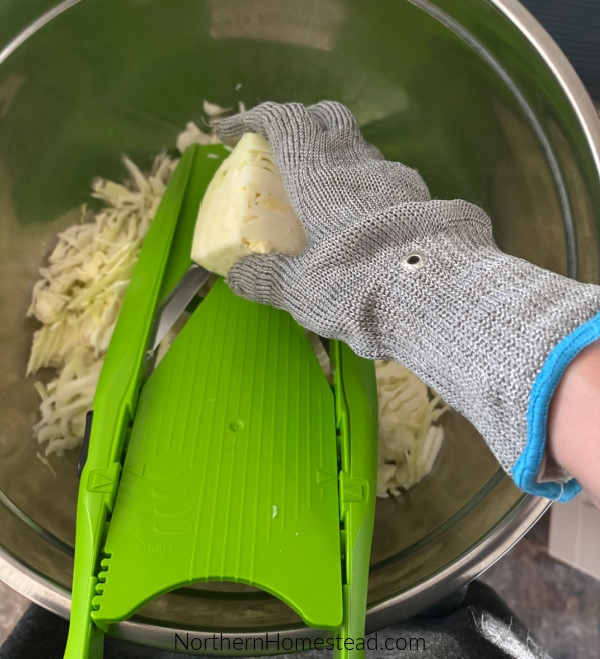
The shredding of the cabbage will depend heavily on the tools you use. For the mandoline, we cut the cabbage into 4 pieces, leaving the core in, and shred it. The thickness depends on your preference. If you like very soft sauerkraut, shred it very thinly. In this case, a special cabbage shredder might be a better option than a mandolin. We enjoy a bit of crunch, so the mandolin on the small setting works great.
The other vegetables, if used, should also be shredded or cut similarly to the cabbage. However, it also depends on your preference.
Adding the salt
Once everything is shredded or sliced, weigh it to calculate the amount of salt needed. We usually work in batches, since it is easier to mix the salt into a smaller amount than into 10 kg.
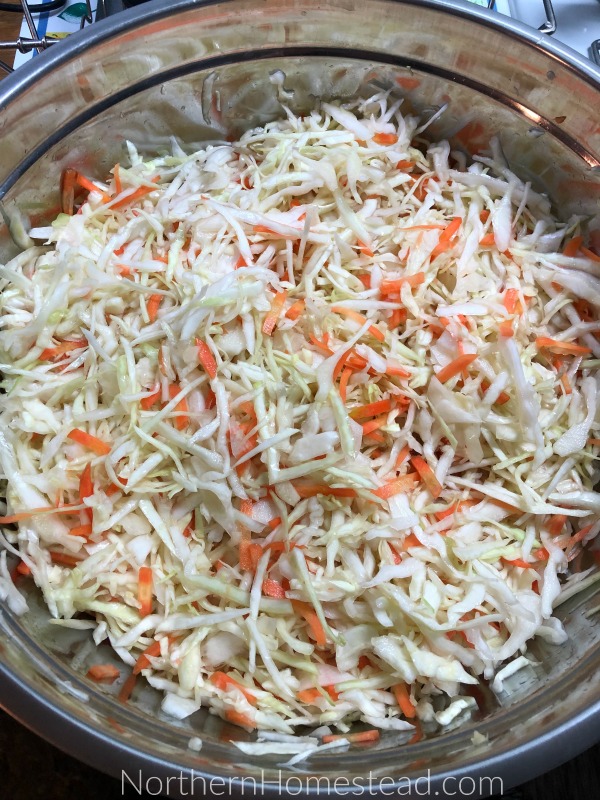
If you are eyeballing the salt or are aiming for a higher percentage, we recommend starting with less and tasting the mixture. You want it to be salty but not overly salty. If you weighed the cabbage and did the math, it should be just right. However, as a begginer still find out on a smaller batch if you prefer 1.5 or 2%, or maybe somewhere in between. If the cabbage is too salty or not salty enough before fermentation, it will not taste good afterward.
Many recipes recommend intensely massaging the cabbage until it’s all soft and juicy. We do not. Just mix well, massaging it a bit to ensure everything is well combined, and you see moisture coming out. Now let it rest for about an hour. The salt will further draw the moisture out of the vegetables. Save yourself some work.
Filling the crock
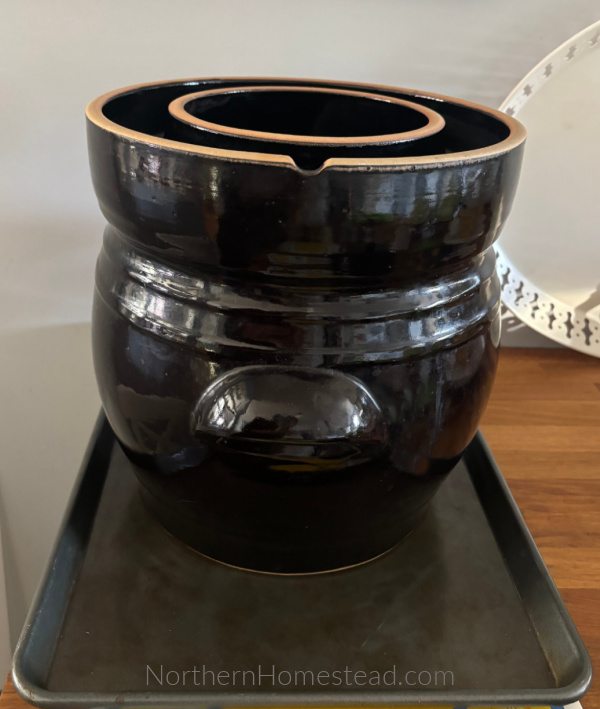
While waiting, ensure the crock and the weighing stones are clean and dry. You don’t have to sterilize them; just a good wash is enough. If needed, we prefer vinegar to soap. Soap tends to leave traces, and we do not want them in our ferment.
If you don’t want to lift a heavy pot, place the empty crock on a baking sheet to catch any overflow. Choose a room temperature location, away from direct sunlight. Even though the stoneware crock is great at keeping the temperature more constant, you still do not want it to get too warm.
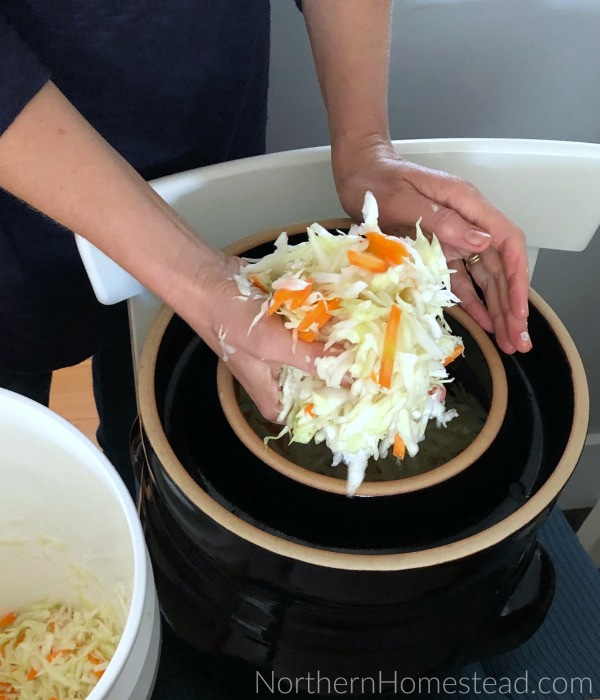
Now, fill the pot with the mixture and press it down. Again, work in batches to have it all filled tightly.
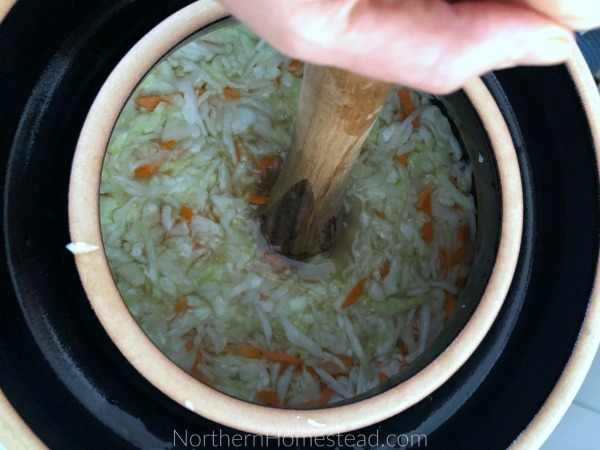
Use the sauerkraut pounder, tamping or pushing down the kraut is important so that the brine comes up. You do not want airpockets in your sauerkraut.
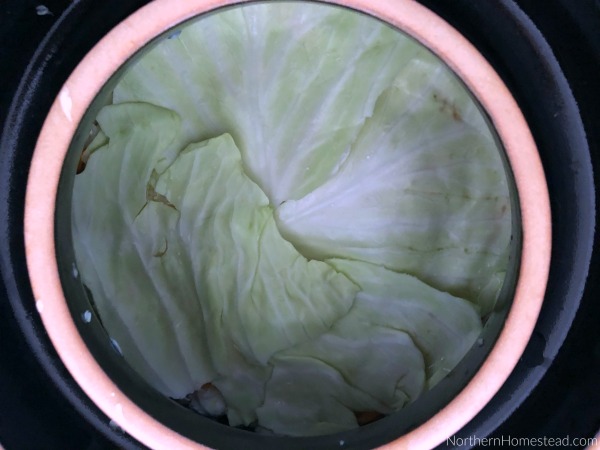
Once all the kraut is in the crock, cover the sauerkraut with the leaves you put aside for it. This is helpful, so no kraut can float on the surface. There will be a lot more fluid going forward.
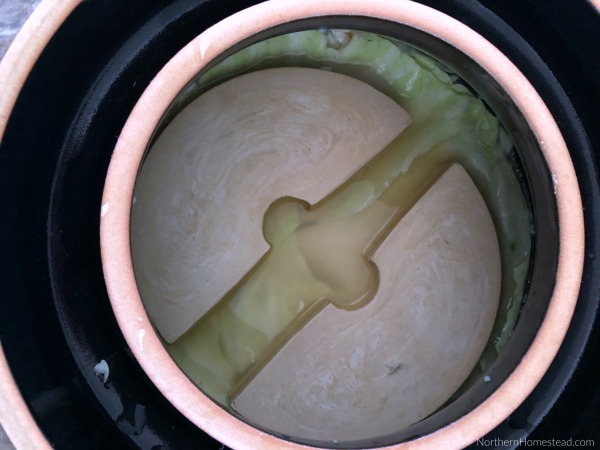
Place the weighing stones on top of the leaves and press them all down. You want to make sure the sauerkraut is fully submerged in liquid. At the beginning, it’s enough if it is moist, see the picture above. As the kraut ferments, it will draw out more moisture.
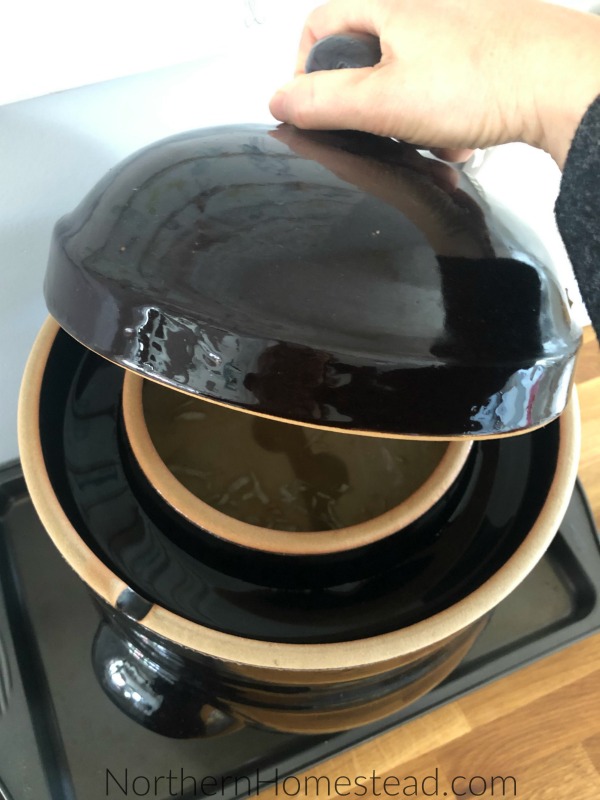
Fill the crock’s moat with water and place the lid on top.
The fermentation process
Keep the fermenting crock at room temperature somewhere where you can still monitor it. After about 18-24 hours, you will start hearing a burping sound. The gases that build up in the pot will start to escape through the airlock.
The burping will get louder and more intense in the next couple of days. It’s supposed to be that way. Enjoy it.
After about a week, it will slow down; now is a good time to taste your sauerkraut. If you like it, it’s done; if you want it to be more sour, you can leave it up to 21 days.
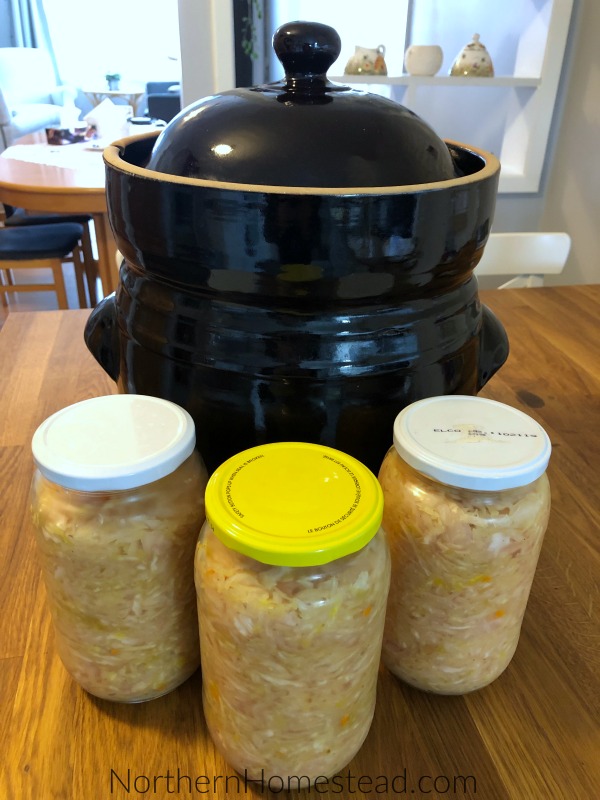
After fermentation is complete to your liking, ladle the finished sauerkraut into jars, pressing it down so it is covered with liquid (very important!). Close the jars tightly and refrigerate them. Alternatively, you can move the whole crock with the sauerkraut to a cool place and draw as much kraut as you want to use. The sauerkraut is good for several months.
Do you enjoy sauerkraut? What is your favorite spice or vegetable to add to the cabbage? Please share in the comments below.
We invite you to subscribe to Northern Homestead and follow us on Instagram, Facebook, or Pinterest for more yummy recipes.









Leave a Reply