
If you follow us on social media, you might have noticed that we talk more about the whole-food plant-based diet. It was time to share our thoughts on the whole-food plant-based diet, what it is, why eat healthily, and the challenges that come with it.
What is a whole-food plant-based diet?
The whole-food plant-based diet emphasizes minimally refined or processed foods. Whole foods, and come from plants such as fruits, berries, whole grains, legumes, vegetables, greens, tubers, seeds, mushrooms, and nuts.
It’s more than just a vegan diet; the emphasis is on unrefined, real food that grows out of the ground as Dr. Greger would define it, where nothing bad is added, nothing good taken away.
The whole-food plant-based diet is about eating healthy. Depending on whom you ask it might also exclude salt, and oil (refined and cold-pressed). Also, not all plant foods are the same. Some are more nutrient-dense, while others have more empty calories.
A healthy, whole-food, plant-based diet is rich in whole, nutrient-dense foods.
Why a whole-food plant-based diet
For us, it began about 9 years ago, when I came across Dr. Fuhrman’s book Eat to Live. It was a game-changer for my health. Since we had 2 fairly picky teenage eaters, I could not see us going all whole-food plant-based or nutritarian, as Dr. Fuhrman calls his diet. I applied only what I could see as feasible for us without losing my sanity in the kitchen.
I added a salad, or just some raw veggies or fruit, to every meal, started using more cruciferous and other vegetables, and reduced processed foods to a minimum.
At the time, I did not see any reason to avoid meat, dairy, or eggs. It sure had to come from healthy sources; otherwise, I was a big supporter of it.
Still, by following Dr. Fuhrma’s diet by about 40% we saw great results. My frequent colds became less frequent, my energy level went up, and as a nice side effect, I went a few sizes down in my clothing, too.
Fast forward to last winter. Kids are gone by now, and the two of us have become more relaxed in our food choices. I used more refined flours in baked goods that often replaced a healthy meal. Even though I was still making almost everything from scratch and mainly choosing wholesome ingredients, our health began to decline. Additionally, we are almost a decade older.
After a hard winter, with a nasty flu for both of us, and stiff limbs for me, I knew we needed to do something fundamentally different.
We love traditional food, but seeing my parents, aunts, and uncles suffer makes me question the traditional foods. I’m confident I do not want to be where they are when I reach their age. I have to explain that I come from a cooking-from-scratch tradition. Homemade food is what I grew up with and have made most of my life, as my parents and most of our extended family did. Honestly, one can make a lot of junk food at home, too. The time to change is now.
I have already seen the significant impact the whole-food plant-based diet had on our personal health when we followed it, even in part. Now, almost a decade later, there is more evidence and information that a whole-food plant-based diet is A Way to go for longevity and health.
For us, the choice to go whole-food plant-based is first and foremost for health reasons. After looking into it more closely, I can see how someone might want to eat this way for ethical and even environmental reasons. It simply makes sense to eat what grows in the ground.
Challenges with the whole-food plant-based diet
I’m very convinced that the whole-food plant-based diet is the best diet for us; however, it is not without challenges.
- Tradition. Traditional food is comforting and comes to mind first. Giving up traditions is not easy. Trying to recreate those traditional foods is partially successful; however, I think there is a better way to go. We have to create new traditions and new favorite meals. This takes time and effort. I’m surprised, though, how tasty those new favorite meals are—for example, cream sauces.
- Work. Searching for new recipes and trying them out is much more work than I expected. I’m a creative cook who loves to combine foods into simple homemade recipes. With traditional recipes, I already had a good idea of what tastes great with what. Whole-food plant-based is a whole new world for me. I’m working on ways to make meals simpler again without sacrificing taste or enjoyment. See the update on Freestyle Cooking.
- Cost. Since many whole-food plant-based recipes use imported ingredients, that most certainly adds to costs. My goal is to create meals mainly using ingredients that can be grown locally, are in season, or are easy to preserve. I must admit I’m not there yet, but we’d like to move from the garden to the table. andUpdate: the surprising ease of plant-based eating.
- Own it. Most recommendations for a truly healthy, whole-food plant-based diet, especially from trusted doctors, make a lot of sense. However, there are some that I feel are like: “You should never drive a car” – because so many people have been killed in a car. Even though it is true that far too many people have been injured and even killed in a car accident, most of us still drive a car because it gets us from A to B. A diet that is salt-, refined sugar-, and oil-free is undoubtedly the healthiest, but some salt, sugar, or oil may help us move from where we have been to where we want to be. We will need to make some decisions to make the whole-food plant-based diet ours.
Taking on the challenge
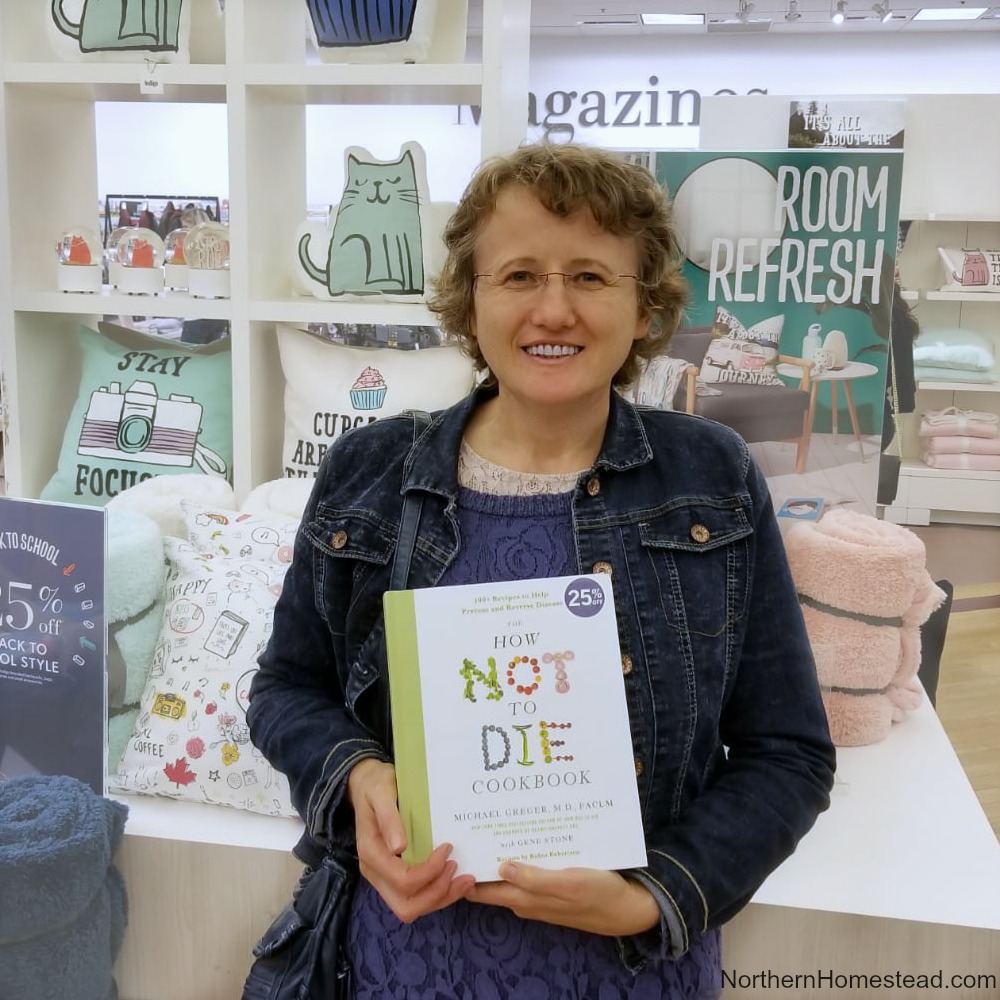
My goal this winter is to tackle those challenges one by one and find suitable solutions. It sure will take some time and even more effort, but it has already been worth it. Can’t wait to see where it will take us. The picture above shows me on my birthday with my new How Not to Die Cookbook ready to face a new decade of my life.
A whole-food plant-based diet is not yet mainstream. However, I’m always happy to see more people discover it and at least try it. It has been interesting to have people over for meals. We mostly receive positive feedback because no one expects a whole-food, plant-based diet to be so delicious.
Are you with us on this? I would love to hear your thoughts on the whole-food plant-based diet. Maybe you too want to improve your health, or just eat more wholesome food. Whatever the goal, we would love for you to follow us.
Since many of our recipes are not whole-food plant-based, and we can’t possibly change that overnight, we ask you to bear with us. Change takes time; know we are working on it. Thank you for your understanding.
Book recommendations:
How not to Die by Dr. Greger
Eat to Live by Dr. Fuhrman
Super Immunity by Rd. Furman
We invite you to subscribe to Northern Homestead and follow us on Facebook or Pinterest for the latest updates.



We we’re whole food plant based for about 4 years. Whole we felt better at first we found that it was hard to sustain without either eating all the time or having more fat in the diet. The carbs provided energy but they weren’t long term. We went full swing the other way to Paleo gluten free. That was a bad idea too. Way too much fat and slowed the digestion way down. We are now in the middle. Lots of veggies, pastured or grass fed meat 4 days a week and plenty of pastured eggs, ghee, quality butter and unprocessed olive oil. Still whole foods. Still lots of veggies and whole grains that are fermented or gluten free and lots of fermented sour kraut, kimchi, kefir and kombucha.
Thank you for sharing your experience CeAnne. All the dietary suggestions out there can be confusing at times. I think we have been where you are now for the last couple years and like I said in the post with great results, meaning much better than before we started eating more veggies, grass-fed meat, and eggs from our own chickens. Wondering if the whole-food plant-based diet you were on wasn’t too high on carbs. We follow more Dr. Fuhrman and Dr. Greger, they suggest fewer carbs, more legumes with nuts and seeds. I don’t feel hungry at all.
I would love to try a whole foods diet..
The expense is difficult.. I planted the higher cost veg this year, and it didn’t do so well..
I agree it would bring better health to all..
The man who nearly died from Chrones disease cured himself by eating only foods found in the Bible..
I wish we had gleaning farms here 🙂
All organic food is expensive. I think the challenge will be to grow as much as we possibly can ourselves.
Hi Anna,
Good for you to be making the bold move back to plant based whole foods! You’ve clearly stated the 4 challenges of doing this, but nothing that can’t be overcome — especially when one feels so much better when adopting this lifestyle. I’m into it also, for about 4 years now with a few detours along the way. Like you said there are lots of conflicting voices out there advocating many other programs but they can be aggravating other health problems and can be complicated to follow too. When I tried to add eggs back into my diet (because I like the taste) I started to notice more stomach issues, bloating, fluid retention and joint pain. So I’m better off without them. It can be fun to create new recipes using what you have on hand and keeping it simple. Have you read about the benefits of soaking nuts and seeds before eating them? Also do the soaking for seeds and non-gluten grains like quinoa, millet, rice, teff, buckwheat and amaranth. It helps provide better digestibility and availability of nutrients.
Thank you for sharing Denise. Yes, I have heard about soaking. I guess I’m not a believer yet that it really makes such a difference. Maybe I need to look into it more.
Hi Anna, i have been on whole plant based foods (vitalstoffreiche Vollwertkost) for 40 years now, also coming from a similiar family background as you describe in your posts. Yes, my grandma and mother did grow their food in their garden and cook and bake from scratch, using refined flour and sugar and even margarine! Grandma died of a stroke at 74 and was very obese, mom died of heart disease and had suffered from osteoarthritis and hyperthyreodism. She had had by-pass surgery etc.
When I was 21, i had a summer job in an American hospital as a nurse aide,, and was shocked at all the conditions my stroke patients had been in. I swore to myself, if there is anything I can do not to end up like this, I will do it for sure. Well, it took a few more years until I discovered the solution. Dr. Bruker and Dr. Schnitzer were German doctors and dentist who passionately informed people about the causes of disease and consequences of processed food, and have been teaching what to do instead. I studied all their teachings and followed them and was able to raise my family in a healthy way – long before Dr. Furman and all the other American doctors came up with their books. The information has been available in German for 50 years and longer, starting in 1930 with the Swiss doctor Bircher-Benner.
Loved reading your story, thank you for sharing. Dr. Bruker’s book was the first one I read about a healthy diet. It was fascinating. We did get a grain mill and a flacker to roll our outs fresh every day. I also stopped using margarine. It sure was a milestone in the right direction. But as I share in the post, Dr. Fuhrman was the one that brought real change for me.
Well yes, the “problem” is the psychological one. It’s not any more expensive to eat Nutritarian (Dr. Fuhrman) than the other way. People don’t understand the program and just find any old thing that says “WFPB”. NO, they are not all created equal. And on a nutrient dense way of eating you only need half the food you were eating when eating the S.A.D. unhealthy way!
For example, vegetables ARE carbs. But when people say “carbs” they really mean starches.
Anyway, like Dr. Fuhrman says it’s not for everyone – most people refuse to do the homework and refuse to give up their precious junk food LOL. They’d rather take medication and eat anything they want even though the medication is not only ineffective but poison.
Thank you for your thoughts. We love Dr. Fuhrman’s recipes and make them very often. And no one is talking about wanting to eat junk food here. We all want to learn and eat and be healthy.