
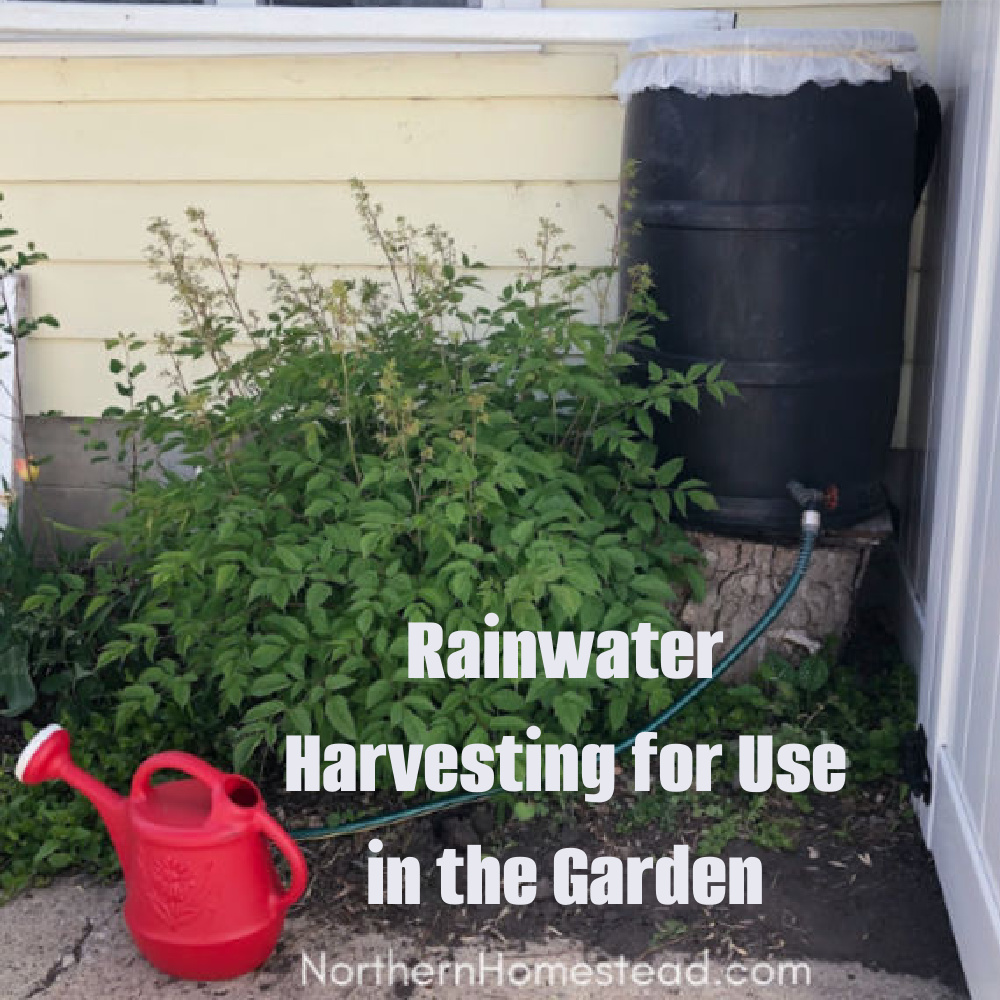
Rainwater is very precious in a dry climate, and we want to conserve it as much as possible. Harvesting rainwater for use in the garden helps us use water that would otherwise go to waste. Plants prefer to be watered with stagnant, warmed water.
Having rainwater around the garden is very convenient, during a dry spring it’s a must-have. We have been collecting rainwater for many years in different ways and places. Here we share some of our experiences.
Rainwater from a rain barrel is much better for the garden than cold tap or well water, which may contain chlorine. The rainwater usually has a good temperature for gardening. Installing a good rainwater harvesting system is worth it, not just for the cost of water but also for the quality.
Why collect rainwater for the garden
Rainwater is free, fairly clean water, a gift from the sky. Even though the water is free, harvesting it might not be legal where you are. Usually, however, if you only use the water in the garden and not in the house, it is not a problem. If in doubt, check with your local municipality.
The rule of thumb is that for every 1/2 inch of rainfall, you get 0.3 gallons per 1 square foot, so a 1,000-square-foot roof collects about 300 gallons of water. That is a lot of water.
The quality of the water depends on the quality of your roof. However, for use in the garden, only two materials seem questionable and are uncommon: fire-retreated wood shingles and copper, as copper is naturally an herbicide and not suitable for the garden (source: Blue Barrel Systems).
The rain-collecting receptacle
To collect rainwater for gardening, we need a suitable, preferably durable, receptacle. It can be a barrel, a tote, a container, a pond, a tank, etc. The bigger the ruff, the bigger the container should be. Here are some options that we are using.
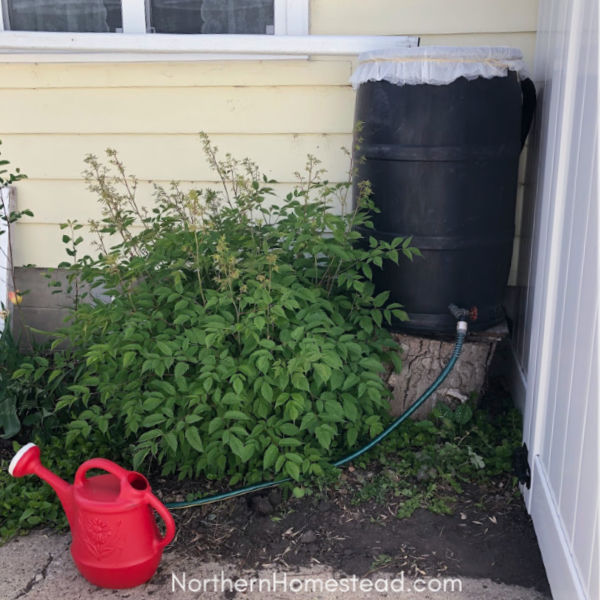
To start, you can use any container to catch the rainwater. The most common are the 45-gallon barrels. We have found that these barrels, despite their small size, are very durable. They come in different colors and are made of different materials. Depending on your roof size, you will need a good overflow for a 45-gallon barrel. Read more below.
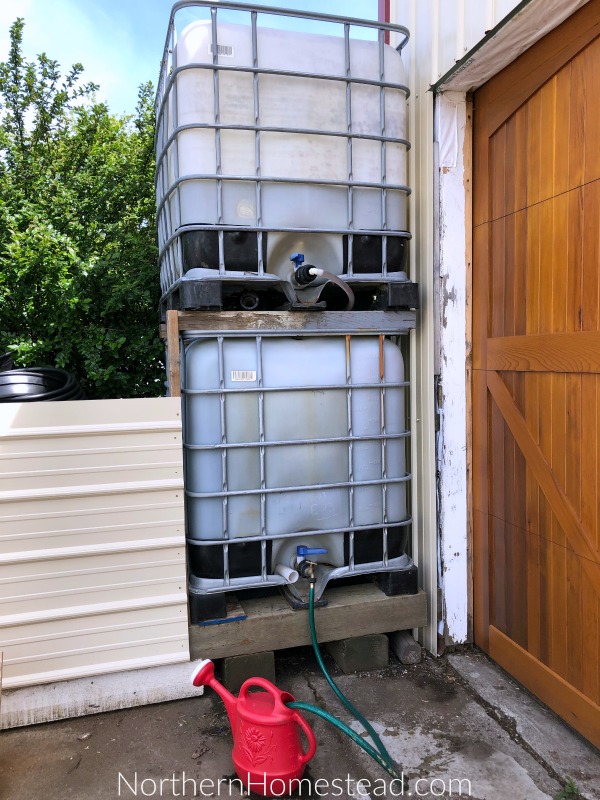
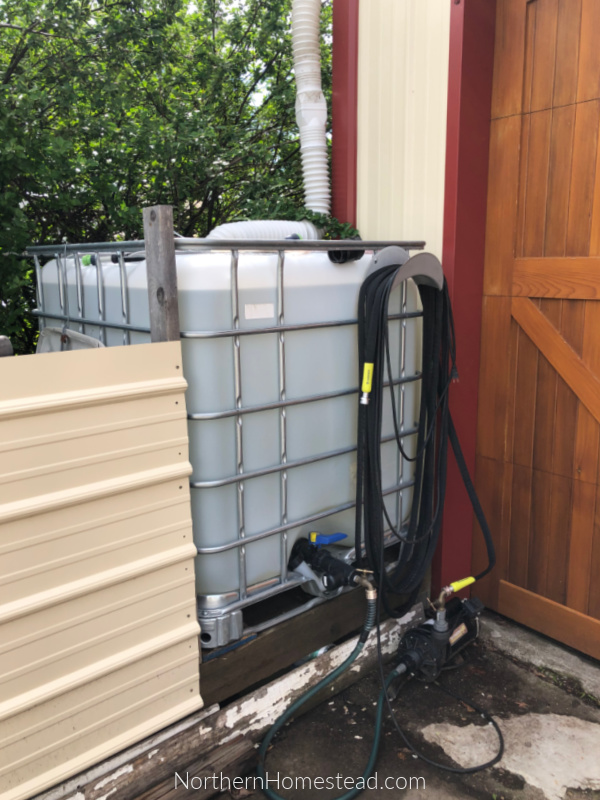
IBC totes are commonly used to collect rainwater for the garden. They usually hold 275 gallons (ca. 1,041 l). They are not very durable, though, so if you are going to use them, look for a good deal, knowing that you will have to replace them every few years.
Our 20′ x 30′ garage roof collects roughly 360 gallons (ca. 1,363 liters) from 1″ of rain. To catch it all, we initially installed two totes on top of each other. The top tote discharge is connected via a plastic tube to the top inlet of the bottom tank. Since the garage is roofed with a pond liner, the water is of great quality and fairly clean.
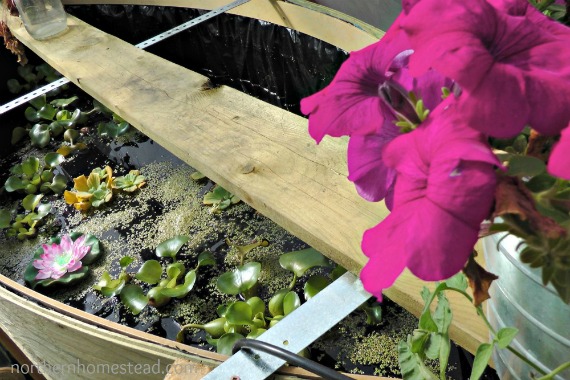
A water tank in a geodesic dome can serve many purposes. A water reserve that is not connected to any roof can still be filled with rainwater by pumping the water over.
The overflow for the water reservoir
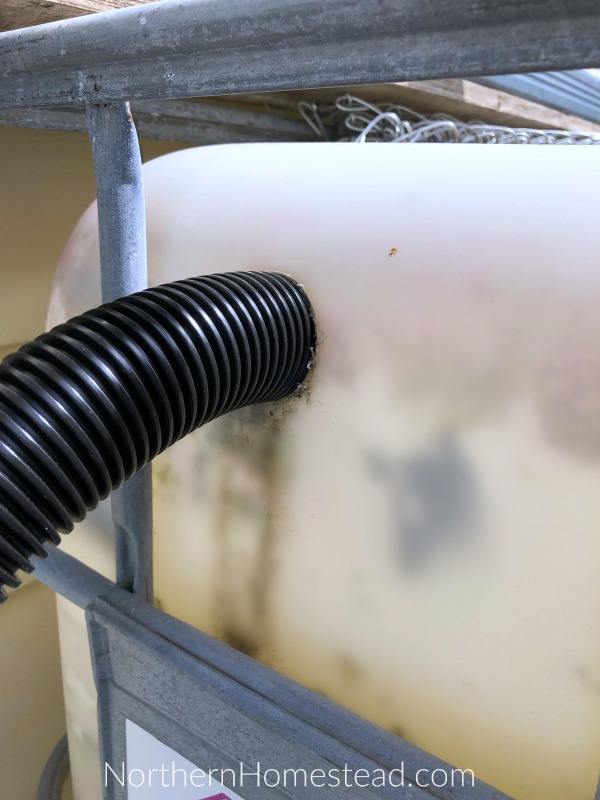
No matter how much water a rain receptacle can hold, eventually, it will be full. A good overflow is a must-have.
A drain hose makes a good overflow. Keep in mind that during heavy rainfall, a lot of water can go through the overflow.
Place the overflow away from the buildings. Ideally, you want to use the overflow to water perennial shrubs and trees. Or make a self-watering system as we did for our Raspberry patch, read more below.
Dirt, algae, and bugs
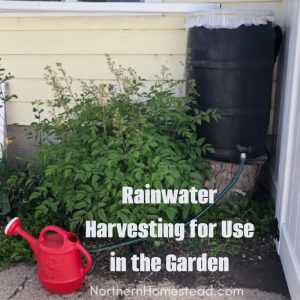
Rain barrels can be a real collecting system, not just for rain but also for dust, dirt, and bugs. If using a simple barrel, keep the lid intact, just make a hole big enough for the downspout. It will help so much to prevent debris from accumulating in the barrel, not to mention all the mosquitoes that can breed in there.
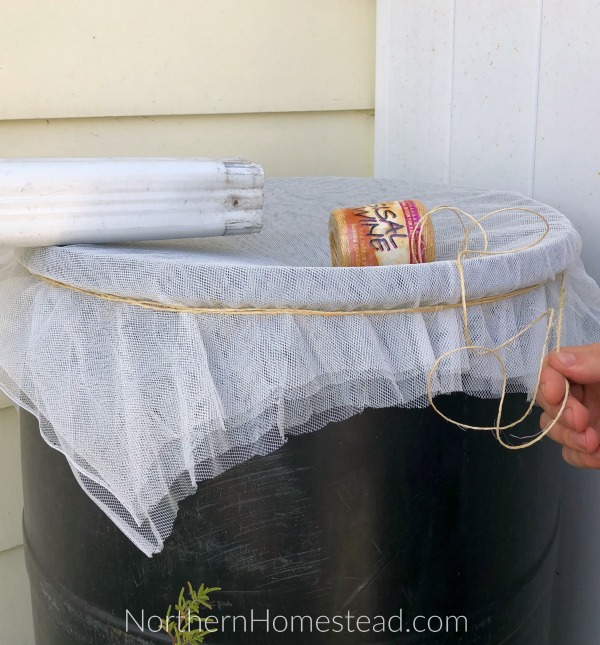
If the barrel has no lid or is open, you can install netting on top. Here, we used IKEA netting curtains, which worked for a while.
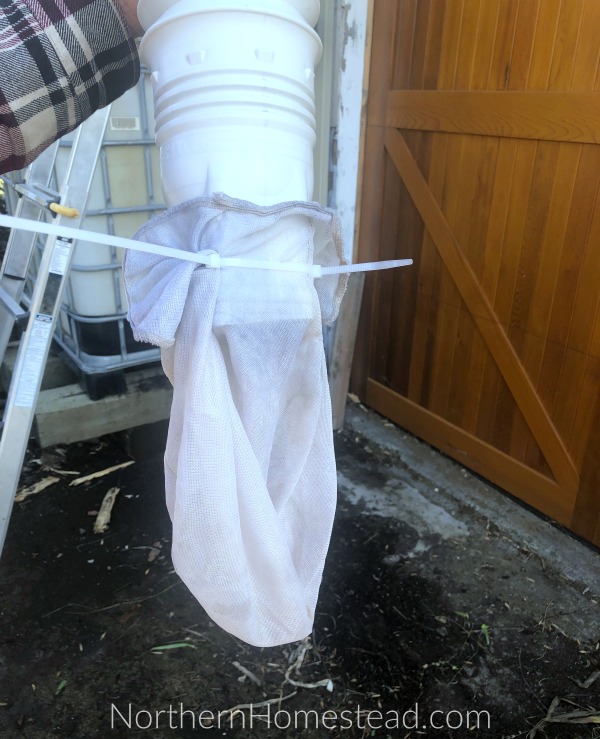
We use a paint strainer attached to the downspout extension hose to catch all the debris from a roof. In spring, the strainer can be cleaned or replaced, since it only costs a few dollars. We get them at the local hardware store. The strainer keeps the water and tank cleaner.
A more permanent solution would be a downspot deverter with a debris catchment basin.
Algae will eventually grow anywhere where it is bright and moist. However, it will not grow overnight. We have used our barrels for many years now without significant algae growth.
A dark barrel will prevent growth much better than a transparent one. Painting or wrapping a barrel or tote can also help. We find that having the barrels on the north side of the house is preferable to the south side, where the sun is much more intense throughout the day.
Preparing the rain barrels for winter
Water expands in a frozen state. Leaving it in the barrel when the temperature drops below freezing will damage the barrel. Emptying the water-harvesting barrel or tote is a must in winter in a cold climate. However, in our experience, you can leave about 1/3 of the water without damage. Use at your own risk. But in our dry climate, the water is very valuable come spring.
In the fall, trees, shrubs, and perennials need watering. This will help them survive the cold winter. It is also convenient because water barrels need to be emptied. It is all part of preparing the garden for winter.
In our experience, emptying alone is not enough. If you don’t divert the discharge of the downspout, then it might happen that during a warm-weather spell, snow will melt and water will again collect in the barrel. This way, we lost one of our totes. It had been emptied in the fall, but not disconnected from the rain gutter. Water entered the tank, and the heavy frost caused it to burst. So, yes, we learned that it is also important to disconnect the water barrel from the gutter in the fall.
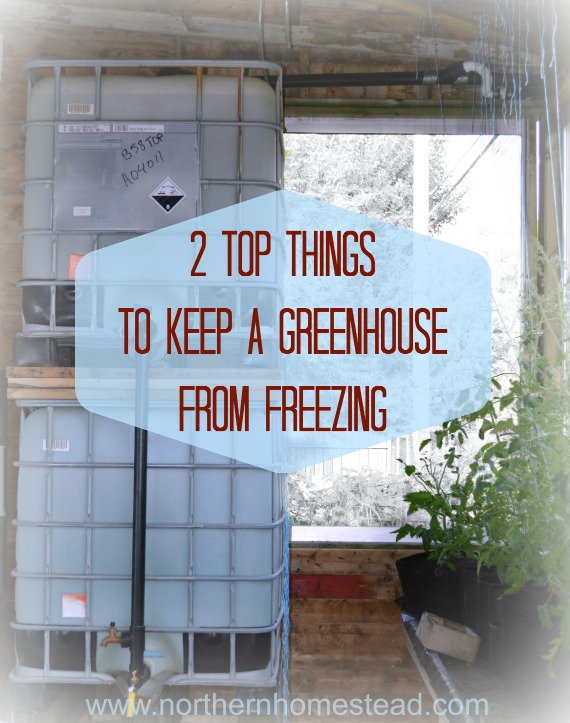
For a few years, we stored our water tanks in the garage. It was amazing because the water never froze, and in winter, the collected water was ready to use during our often-dry springs. If space is available to collect water in a building in a cold climate, it is a great option. The water also served as a much-needed thermal mass.
Using rainwater in the garden
Just collecting rainwater without making it easy to use is not very helpful. We collect the water not just to have it, but to use it. Every barrel in our place has a spigot at the bottom. We also like to attach a short hose to it for easier filling of a watering can.
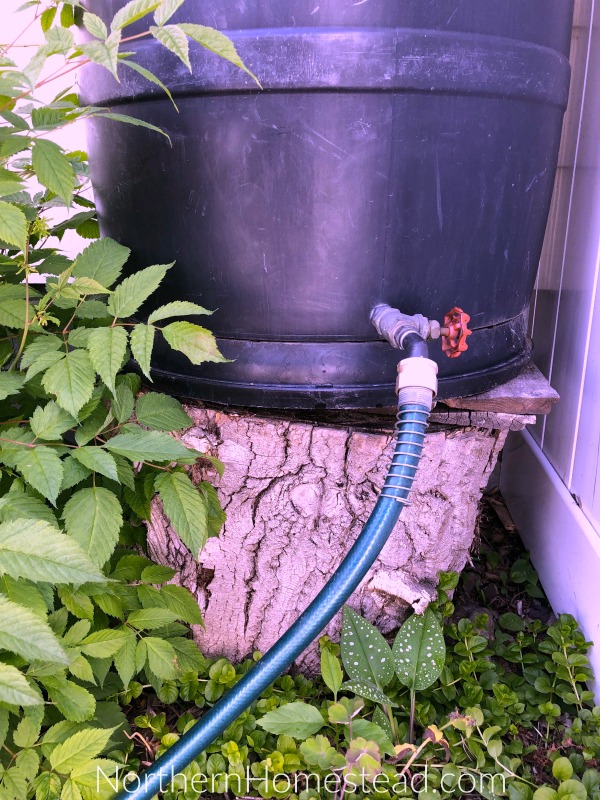
To use gravity more effectively, it also helps to elevate the tank to increase pressure. The water flow this way is much faster, and it’s more enjoyable to use.
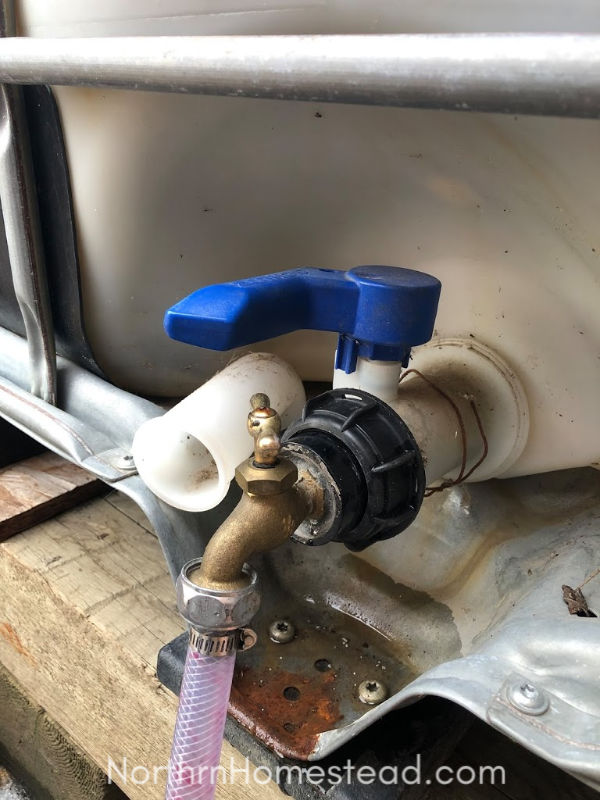
For the tote tank, we used a drain adapter from the original outlet. The water tank system also has a connection to a pump and a garden hose. We use a repurposed hot tub Flo-Master pump and a hose long enough to reach the farthest corners of the garden. During dry periods, this is really convenient.
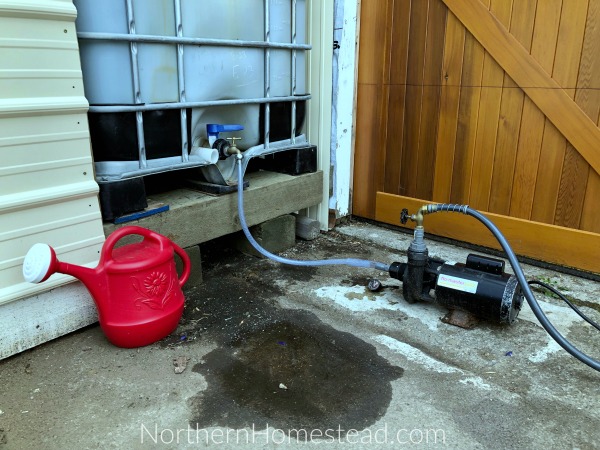
Also, if there is a lot of rainwater, it is easy to pump it over to the geodesic dome greenhouse water tank. or any other water collection that is not attached to a roof.
Here is a short video to show the setup in action:
Self-watering rainwater harvest
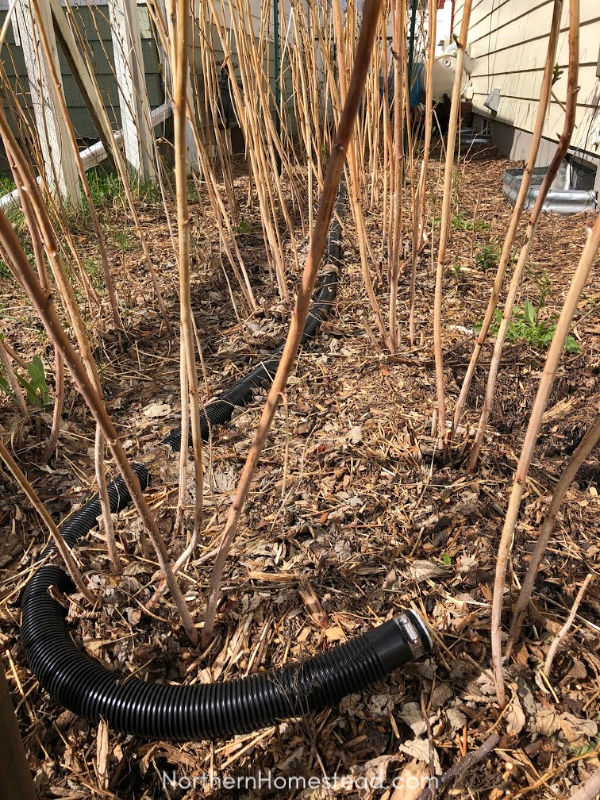
Having rainwater ready to use is great, but in some cases, it can be convenient to divert it to a spot in your garden where you need it in greater amounts. With this kind of self-watering rainwater system, you irrigate the perennials or food forests and let the ground collect the rainwater. Not suitable for a vegetable garden, since the watering only happens when it actually rains. As an afterthought, we installed a lock and overflow; there are many options for this idea.
A well-mulched food forest can absorb a lot of water at once and then release it over time to the roots.
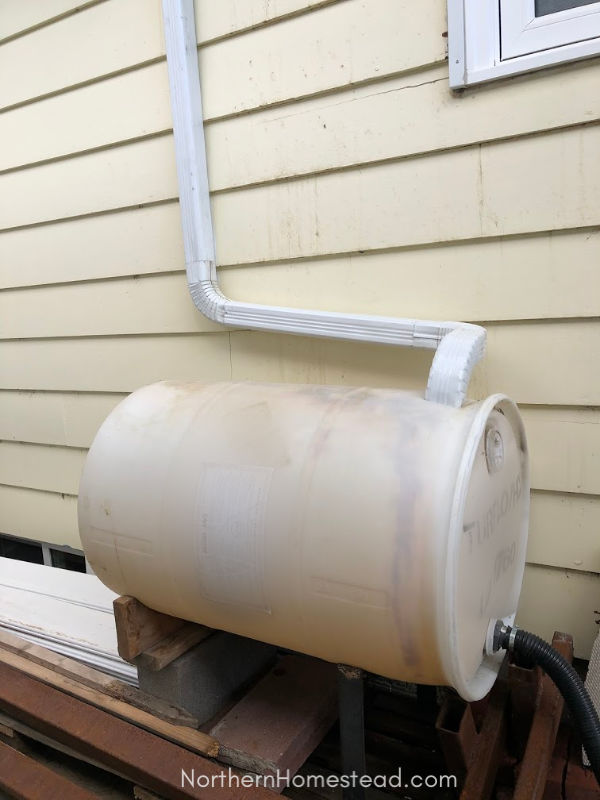
On the back side of our house, the water barrel is not easily accessible. The horizontally installed barrel functions as a buffer for the self-watering system. The rainwater will accumulate in the barrel only during heavy rain and be released when the rain stops. We installed a 1.5″ hose inside the raspberry patch and drilled 1/8″ holes every foot along the upper side. This is a poor man’s soaker hose that releases water without any pressure.
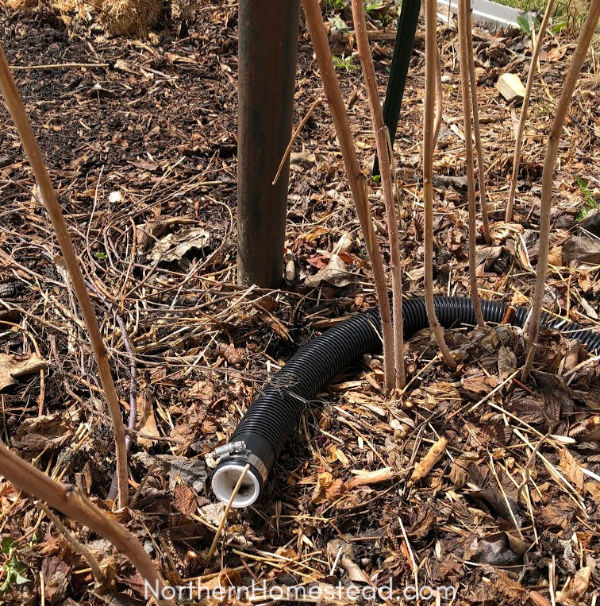
A plug at the far end of the hose prevents water from going straight through it. Place it alongside the plants you want to irrigate, and drill enough holes in the hose so that they collectively have the same throughput as the hose itself. It works great; not only do we collect the water from that side of the roof, but the watering also happens on its own.
We invite you to subscribe to Northern Homestead and follow us on Instagram, Facebook, or Pinterest for the latest updates.



Our winter accumulation of snow on our roofs results in a destruction of the gutters when sliding occurs. Do you have any suggestions on dealing with this?
We do not have that problem, but google search gave this suggestion, seems interesting.
Your Website is quite interesting, I,’ve Bern following for quite a while. However, living in Germany, I ned metric measures,
We are working on a German website, stay tuned. 40′ x 20′ roof is about 74 m2a, and 500 US gallons is about 1892 litter. Hope this helps.
Hello,
I have 5 gal buckets positioned under where the water runs off the roof. Nothing fancy. Another 20 gal metal pot is set under a downspout behind the shed roof. Rather primitive collection system. I need to develop a more permanent solution.
You say to empty the water barrel for winter. But that’s when we get all our rains in Calif. It does freeze intermittently during winter, so if I were to always empty out the barrels I’d end up with not much water after winter is over. Rain ends in early spring. I guess it’s a bit of a balancing act depending on your expected weather? Does it also depend on the size and material the water container is made of? My 5 gal buckets survive fairly well for a few seasons. The sun also breaks down the plastic quickly.
It depends on the temperature you have in winter. We get down to -40, so even a huge water tank can freeze all through and burst. If you don’t get much of a freeze, by all means keep your water in the winter and collect it.
I love this post. Is the water in the top containers clean enough to drink?
Thank you, Shirley. The water is not safe to drink without filtering.
Hi Anna,
As ever, I enjoy your mix of ingenuity and affordability in the systems you have created for your homestead.
I have bookmarked this (again I have bookmarked one of your your articles) as we have softened water, so sodium that is not great for plants. If I haul water, I can get it from a nearby spring, but heavy. Definitely going to set up something like this!
Btw, your post on what plants can deal with low temperatures has proved to be invaluable at the moment. It has been snowing here for two days!
Thank you for your kind words, it is nice to hear that what we share is helpful. I hope your snow melts quickly and the growing can begin in full swing.
My wife has recently started gardening as her hobby and I want to help her find more efficient ways to keep up her yard projects. I really appreciate your examples on how to use and maintain a rainwater tank to have a recyclable source of gardening water because my wife wants to stay as eco-friendly as possible when doing her gardening but I would have suggested against using rainwater until I read your tips on how to keep it clean and usable. I’ll be sure to remember the rest of your tips while looking for water tanks we can use to store the water in. Thank you!
We have 2 large totes for our rain water, each one holds over 300 gallons (US) we have them stacked on the north side of the hose right on the west edge. Our shingle roof is over 900 square feet. The totes are wrapped in 4 layers of black plastic to keep the light out then in 2 layers of very thick clear plastic, and there is also a 20 gallon first flush system for the dirtier water. These totes are now about 7 years old and holding up well. We do have an window screen to filter the water and an old sock to keep the finer stuff out. We also just added gutters and a 50 gallon barrel to our 8 X 12 foot shed. Can never have to much, especially if it’s a Drier summer